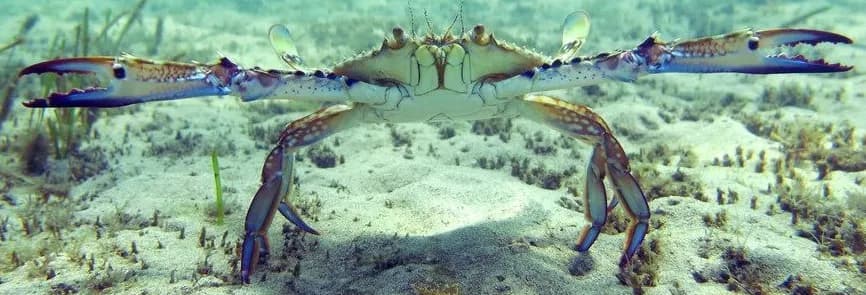
The Blue Swimmer Crab (Portunus armatus) is a fast-moving, brightly colored marine crab species found in shallow coastal waters across the Indo-Pacific.
Scientific Name
Portunus armatus
Habitat
Found in sandy or muddy bottoms of bays, estuaries, and coastal shallows. Prefers warm, tropical and subtropical waters.
Conservation
Not currently endangered, but overfishing and habitat loss due to coastal development are emerging concerns.
Lifespan
Typically lives up to 2–3 years in the wild.
Fun Fact
Blue swimmer crabs can swim sideways and backwards using their flattened rear legs that act like paddles.
Diet
Omnivorous – feeds on small fish, mollusks, worms, detritus, and plant material.
Average Size
Carapace width can reach up to 20 cm; males are generally larger than females.
Location / Placement info
Displayed in the Coastal Reef Exhibit, near the Ocean-View Tunnel
FAQ
What is the lifespan of a Blue Swimmer Crab?
Typically 2–3 years in the wild, depending on predation and environment.
What do they eat?
They are omnivorous scavengers, feeding on fish, mollusks, detritus, and algae.
Are they aggressive?
They are not aggressive to humans but can pinch defensively with their strong claws.
What is the ideal habitat?
Shallow coastal waters, sandy or muddy bottoms, and estuaries with seagrass beds.
Do they swim?
Yes, they have flattened paddle-like hind legs adapted for fast swimming.
How big do they grow?
Males can reach 20–25 cm (8–10 in) across the carapace; females are usually smaller.
Blue Swimmer Crab – Diet, Habitat, Size & Conservation

 )
)