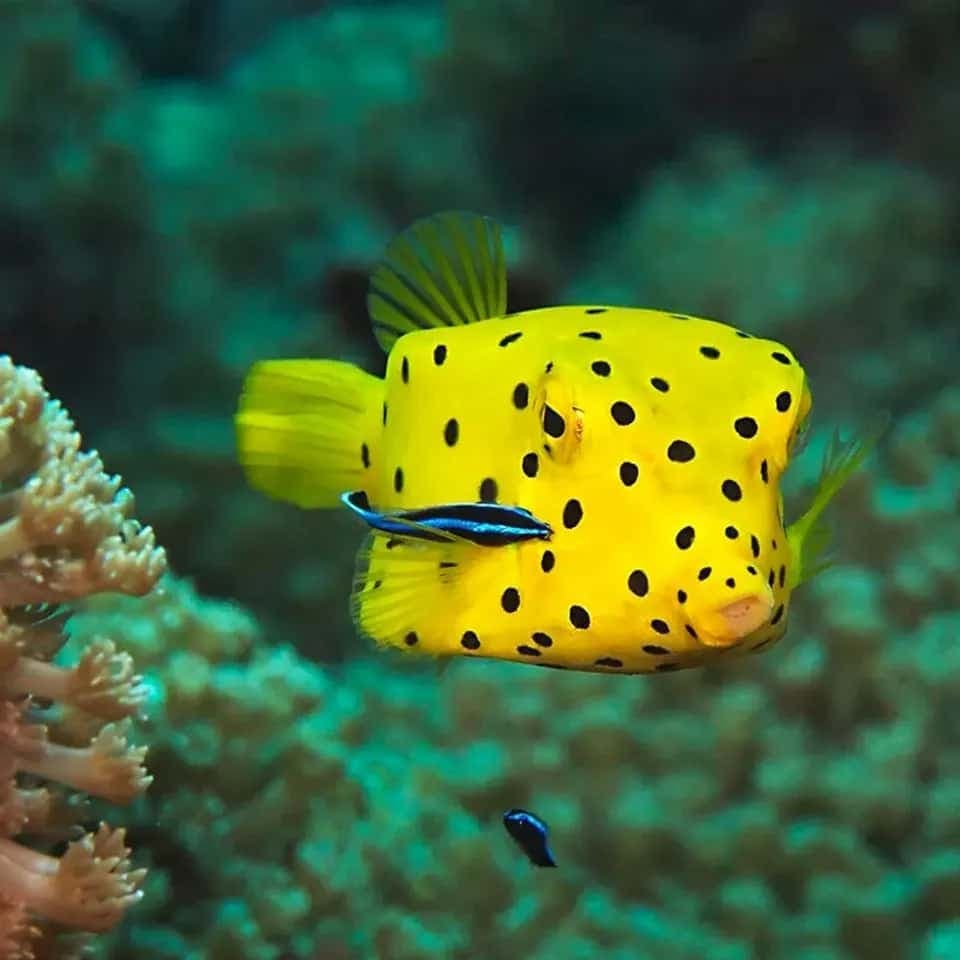
The Spiny Box Puffer is a distinctive marine fish also known as the Web Burrfish or Striped Burrfish. It has a rounded body covered with short, fixed spines, a yellowish to tan coloration with dark markings, and strong beak-like teeth used for crushing hard-shelled prey.
Scientific Name
Chilomycterus schoepfii
Habitat
Coastal marine waters of the Western Atlantic, including seagrass beds, sandy bottoms, reef margins, and shallow coastal areas. Its range extends from the southeastern United States and Bahamas through the Caribbean to Brazil.
Conservation
Least Concern
Lifespan
Around 5–10 years in captivity; lifespan can vary depending on environmental conditions and care.
Fun Fact
Unlike porcupine puffers, the Spiny Box Puffer has short spines that remain permanently erect. It also has powerful fused teeth that continue growing and must be naturally worn down by eating hard-shelled food.
Diet
Carnivore – feeds mainly on hard-shelled invertebrates such as mollusks, crabs, shrimp, sea urchins, and other marine invertebrates.
Average Size
Up to approximately 25–28 cm (10–11 inches) in length.
Location / Placement info
Displayed in the Coastal Reef Exhibit, near the Ocean-View Tunnel
FAQ
What is a Spiny Box Puffer?
The Spiny Box Puffer, also called the Striped Burrfish, is a marine fish with a rounded body covered in short, permanently erect spines. Its scientific name is Chilomycterus schoepfii.
Is the Spiny Box Puffer a freshwater fish?
No. It is a marine saltwater fish found mainly in shallow coastal waters, seagrass beds, and reef areas.
What does the Spiny Box Puffer eat?
It is a carnivore that feeds on hard-shelled animals such as crabs, mollusks, shrimp, sea urchins, and other marine invertebrates.
Can the Spiny Box Puffer inflate its body?
Yes. When threatened, it can take in water and inflate its body, making its spines more prominent and making it difficult for predators to swallow.
How large can a Spiny Box Puffer grow?
It can reach approximately 28 cm (11 inches) in length.

 )
)