Why Visit an Aquarium: Benefits for All Ages
By Anurag Kamboj, Writer, Aquarium Paradise
Published
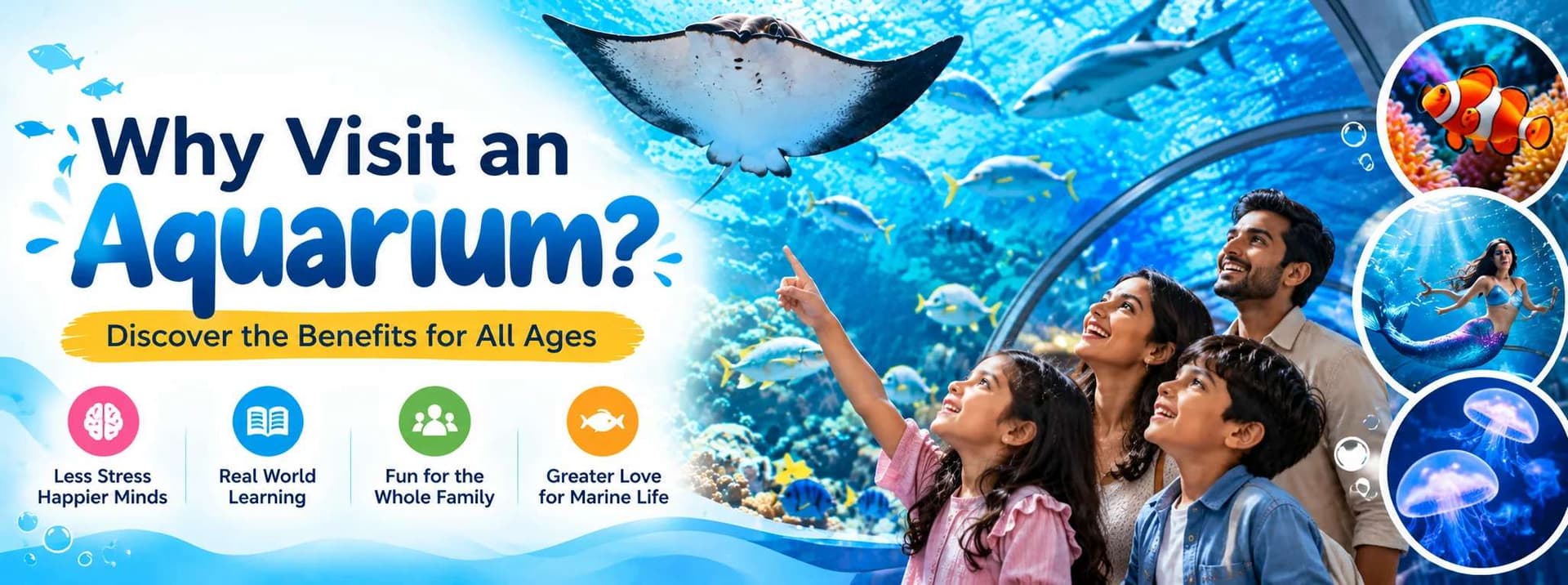
Most families visit aquariums for the obvious reason: children enjoy it. What is less widely known is that the benefits of visiting an aquarium extend well beyond entertainment. Research published in the journal Environment and Behaviour by Plymouth University and the National Marine Aquarium found that watching a well-stocked aquarium for as little as five minutes reduced heart rate and blood pressure in participants. Mood improved. Attention held longer. These effects were measurable, consistent, and independent of how much participants knew about marine life beforehand.
This article covers the specific, research-backed reasons to visit an aquarium across different age groups - children, adults, and families together. It also covers what makes a public aquarium visit different from watching marine content on a screen, and what the Aquarium Paradise experience in Bangalore offers as a local example of these benefits in practice.

Child Ticket - Aquarium Paradise

Adult Ticket - Aquarium Paradise

FUNWEDNESDAY – Buy 1, Get 1 Free
The Science Behind Aquarium Visit Benefits
What Research Actually Shows
The Plymouth University study, conducted at the National Marine Aquarium in the UK, measured participants' physical and psychological responses as fish numbers in an exhibit gradually increased. As more fish appeared, participants' heart rates and blood pressure dropped. Their attention held for longer. Their reported mood improved. The study was published in Environment and Behaviour, a peer-reviewed journal, and is currently one of the strongest pieces of evidence for the wellbeing benefits of aquarium visits in a public setting.
A separate study from the Plymouth Student Scientist journal observed children's behaviour across two weeks at the same aquarium. The researchers found a calming effect on behaviour and an increase in measurable happiness levels during both weeks. Children who engaged in structured activities during their visit stayed longer and remained calmer throughout. Both studies align with what researchers call "restorative environment theory" - the idea that natural environments, including underwater ones, allow the brain to shift from active, directed attention to a softer, more restful form of engagement.
These findings matter practically. An aquarium visit is not just a day out. The aquarium visit benefits documented in these studies suggest that the experience has a genuine physiological effect - one that is accessible to most families, does not require equipment or preparation, and works across age groups.
Aquarium Visit Benefits for Children
Educational Value That Sticks
The aquarium visit benefits for children start with learning, but not in the way a classroom lesson works. Aquariums provide direct visual access to species that children read about in textbooks - sharks, rays, jellyfish, coral reef fish, freshwater species. When a child sees a stingray move overhead through a glass tunnel, the information about that animal becomes three-dimensional. It is no longer a diagram on a page. It is a living creature with a specific movement pattern, a particular size, and observable behaviour.
This kind of direct encounter produces stronger memory retention than equivalent instruction. Educational psychology research consistently shows that multi-sensory, direct observation creates more durable learning than reading alone. For children studying ecosystems, food chains, and marine biology in school from Class 4 onwards, an aquarium visit reinforces and extends what they are already learning without feeling like more school.
The Fish Explorer section at Aquarium Paradise provides detailed species profiles for most of what children see during the visit. Parents who want to extend the learning after the outing can use these profiles to continue conversations at home.
Calming Effect on Children's Behaviour
The Plymouth research finding that aquarium visits have a calming effect on children's behaviour is consistent with what parents and teachers observe informally. Children who are hyperactive in other environments tend to slow down at aquarium exhibits. The movement of fish is rhythmic and unpredictable in equal measure - it holds attention without demanding active response. Children watch without needing to touch, compete, or perform.
For children who find large, noisy environments overstimulating, an aquarium offers a distinct sensory profile: dim or ambient lighting, contained spaces, slow movement, and low sound levels. Multiple paediatric studies have documented calming and stress-reduction effects in children's ward settings where aquarium displays were installed. The same mechanisms apply in a public aquarium setting.
The jellyfish gallery at Aquarium Paradise specifically reflects this dynamic. The cylindrical tanks are lit softly, positioned at children's eye level, and the movement of the jellyfish is slow and regular. Most children spend longer here than at any other section, and they do so quietly. That is the calming effect in practice.
Conservation Awareness That Begins Early
One of the less discussed aquarium visit benefits for children is the foundation it builds for conservation thinking. A child who has watched a shark pass overhead at close range has a different relationship to that species than one who has never seen it. Conservation education that connects to direct experience is more likely to produce lasting attitudes than abstract instruction.
Aquarium Paradise's exhibits include information about the conservation status of various species - which ones are threatened, why, and what affects their survival. The article on marine life ecosystems on the Aquarium Paradise blog covers this context in detail and is worth reading before or after a visit with older children.
Aquarium Visit Benefits for Adults
Stress Reduction and Blood Pressure
The aquarium visit benefits for adults are primarily physiological. The Plymouth University study found measurable reductions in heart rate and blood pressure after five minutes of watching a well-stocked aquarium. These reductions occurred without any instruction, effort, or active participation from the participants. They simply watched.
For adults managing work stress, the mechanism is directly relevant. Urban environments are full of directed attention demands: screens, deadlines, decisions, noise. An aquarium provides the opposite - a natural environment that holds attention passively, allowing the brain's directed attention systems to rest. Researchers at Plymouth specifically noted this in their commentary: "In times of higher work stress and crowded urban living, aquariums can step in and provide a form of calm and relaxation."
This is not an argument for visiting an aquarium instead of other forms of stress management. It is an observation that the benefits of visiting an aquarium include a genuine, measurable physiological response that most adults do not expect from a day-out activity.
Mood Improvement and Attention
The same study found that mood improved and attention held for longer as fish numbers increased in the exhibit. Participants reported feeling more positive and less fatigued after the exposure. These effects are consistent with wider research on "blue spaces" - natural water environments - which links proximity to water with mood improvement and reduced anxiety.
For adults visiting Aquarium Paradise, the 70-metre underwater tunnel at the centre of the experience places visitors within a fully enclosed water environment. Fish pass on both sides and overhead simultaneously. The scale is large enough that the effect mirrors what the research describes: sustained, effortless attention and a measurable shift in mood.
Perspective and Presence
One benefit that does not appear in clinical studies but is consistently reported by adult visitors to public aquariums is a shift in perspective. Being surrounded by deep-sea creatures, large schooling fish, or a slow-moving ray has a quality of scale contrast that is difficult to encounter in daily city life. The experience is grounding in a specific way. Adults consistently describe feeling more present and less preoccupied after time in a large aquarium.
This is not a therapeutic claim. It is an observation about what the reasons to visit an aquarium include for adults beyond accompanying children. Many adults who grew up visiting aquariums as children continue visiting them without any child in tow - the experience has independent value.
Aquarium Family Outing Benefits
A Shared Experience Across Age Groups
Most family outings serve one age group primarily. Amusement parks suit older children and adults. Playgrounds suit toddlers. Museums suit school-age children with specific interests. One of the strongest aquarium family outing benefits is that the experience genuinely works across a very wide age range - from children aged 3 to grandparents - without requiring different tracks through the venue.
Younger children engage with the visual, tactile qualities of the exhibit: large fish, bright colours, movement. Older children engage with the educational content: species names, habitat information, conservation context. Adults engage with the sensory and psychological reset the environment provides. All three groups move through the same space, see the same exhibits, and have something to talk about at each section. That creates the kind of shared experience that a day out is actually for.
The Mermaid Show at Aquarium Paradise is a clear example of this cross-age appeal. The performance inside the tunnel entertains young children through the spectacle. Older children find the theatrical element interesting. Adults enjoy watching their children's reactions as much as the show itself. The show is included in the standard entry ticket - no additional charge.
Low Physical Demand with High Engagement
Another practical aquarium family outing benefit is the low physical demand. The route through Aquarium Paradise is continuous, on flat ground, and does not require significant walking distances. This makes it suitable for families with toddlers in prams, elderly grandparents, or family members with limited mobility. The entire visit takes 2 to 2.5 hours at a comfortable pace - long enough for a meaningful outing, not so long that it becomes tiring.
The aquarium is fully indoors and air-conditioned. This matters in Bangalore's climate, where outdoor outings between March and June require planning around heat. Aquarium Paradise is a reliable option regardless of weather or season - it operates from 10:00 a.m. to 08:00 p.m. daily, including weekends and most public holidays. Tickets and current pricing are on the Aquarium Paradise tickets page.
Why Aquariums Are Worth Visiting: What a Screen Cannot Replace
This is a question worth addressing directly, because streaming services now offer high-quality marine content that is more visually polished than any aquarium exhibit. Why aquariums are worth visiting despite this comes down to three things that a screen cannot replicate.
First, physical presence. The blood pressure and heart rate reductions documented in the Plymouth study did not occur in response to watching marine content on a screen. They occurred in response to being physically near a large aquarium. The mechanism is proximity to a natural environment, not visual information about one. A documentary about jellyfish does not produce the same calming effect as standing in front of a tank of jellyfish.
Second, scale and context. A shark on a screen has no spatial relationship to the viewer. A shark passing two metres overhead through a glass tunnel does. The scale experience - understanding the actual size of a manta ray or the depth of a coral reef tank - is only available in person.
Third, shared experience. Watching a documentary is individual. Watching the Mermaid Show at Aquarium Paradise with a six-year-old is relational. The experience is created by both people being present in the same space at the same moment. That shared quality is precisely what makes aquarium visits one of the more durable family outing reasons to visit an aquarium.
For families planning a visit to Aquarium Paradise, current offers including group rates and combo deals with Fun World are available on the offers page. Schools and large groups can book through the group bookings page.
FAQs
Q1. What are the main benefits of visiting an aquarium?
Research shows that aquarium visits reduce heart rate and blood pressure, improve mood, and have a calming effect on both children and adults. They also provide direct educational engagement with marine species and create shared family experiences that screen-based content cannot replicate.
Q2. Are aquarium visit benefits for children supported by research?
Yes. A study published in the Plymouth Student Scientist found that aquarium visits had a calming effect on children's behaviour and increased happiness levels. Multiple paediatric studies have also documented reduced stress in children exposed to aquarium environments in hospital settings.
Q3. Why is an aquarium visit better than watching a marine documentary?
Physical proximity to a large aquarium produces measurable physiological effects - reduced heart rate, lower blood pressure - that watching a screen does not. Scale, shared experience, and sensory presence are all only available in person. These are the core reasons why aquariums are worth visiting independently of their educational value.
Q4. What makes Aquarium Paradise in Bangalore worth visiting for families?
Aquarium Paradise features India's longest 180-degree underwater tunnel at 70 metres, a jellyfish gallery, a Mermaid Show included in entry, and an indoor waterfall. It is fully air-conditioned, open daily from 10:00 a.m. to 08:00 p.m., and works for children aged 3 and above. A full visit takes 2 to 2.5 hours.
Q5. What are the benefits of an aquarium outing for adults without children?
The Plymouth University study found that watching a well-stocked aquarium for five minutes reduced heart rate and blood pressure and improved mood in adult participants. Adults visiting aquariums independently report stress reduction, improved focus, and a sense of perspective that is distinct from other leisure activities.
Also Read
Writer, Aquarium Paradise
Anurag Kamboj writes the Aquarium Paradise blog, covering marine life, exhibits, ticket offers and practical tips for planning a family visit to Bengaluru's aquarium.
- Aquariums
- Marine life
- Family days out in Bengaluru
More To Read

6.17.2025
Top 10 Largest Crab Species Worldwide
Compare the largest crab in the world like the Japanese Spider and Coconut Crab. Explore traits, habitats, and conservation efforts. Click to know more!
%201.webp&w=1920&q=75)
9.4.2025
Top 20 Kids' Fun Places in Bangalore in 2026
Find the best kids’ fun places in Bangalore in 2026, from Aquarium Paradise and Snow City to Cubbon Park and Bannerghatta. Indoor & outdoor picks for every age.

5.22.2025
Explore the Mesmerizing Aqua Tunnel in Bengaluru
Discover Bengaluru's Aqua Tunnel, a top tourist spot with stunning aquatic displays and interactive experiences. Plan your visit today!

5.16.2025
Mesmerising Little Mermaid Shows Near You
Discover the magic of Aquarium Paradise in Bangalore with its unique underwater tunnel, mermaid show, and interactive marine experiences. Get more info here.
Recommended for you
Explore more from Aquarium Paradise and related picks tailored to this page.
